What an IFSC code means
IFSC stands for Indian Financial System Code. It identifies a bank branch participating in Indian electronic payment systems. You are normally asked for it when adding a beneficiary for NEFT, RTGS or an account-and-IFSC based IMPS transfer.
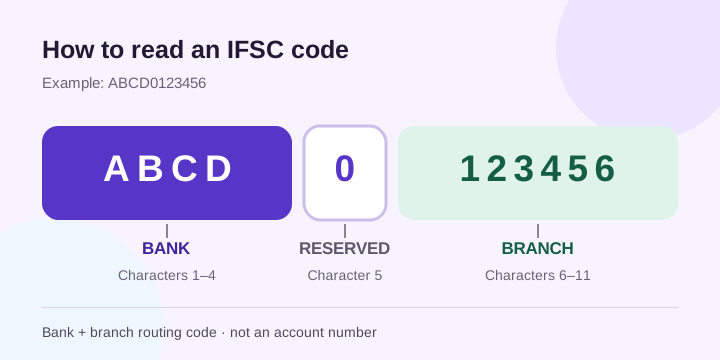
An IFSC identifies the bank and branch; it does not identify the customer or replace the beneficiary’s account number.
How to read the 11 characters
Example: in ABCD0123456, ABCD identifies the bank, 0 is reserved, and 123456 identifies the branch.
Where to find the correct IFSC
- Check the latest cheque leaf, passbook or official bank app.
- Use this site’s RBI-verified branch directory and match the complete address.
- Confirm with the bank when the branch has merged, moved or changed name.
Do not rely on an old screenshot or a code forwarded in a message. Branch mergers can make previously valid codes obsolete.
Verify before transferring money
After entering the IFSC and account number, compare the beneficiary name displayed by your bank with the intended recipient. If anything differs, stop and verify independently.
- Match the bank name, branch and address.
- Recheck every digit of the beneficiary account number.
- Consider a small test transfer when paying a new beneficiary.
- Never share an OTP, UPI PIN, card PIN or internet-banking password.
IFSC in NEFT, RTGS and IMPS
| System | How it settles | Typical use |
|---|---|---|
| NEFT | Processed in half-hourly batches, 24x7 | Routine account-to-account transfers |
| RTGS | Settled individually in real time, 24x7 | Time-sensitive, high-value transfers |
| IMPS | Instant payment service available round the clock | Immediate retail transfers |
Your bank may apply its own channel availability, limits and charges. Check its official app or website before transferring.
IFSC compared with MICR
| IFSC | MICR |
|---|---|
| 11 alphanumeric characters | 9 digits |
| Routes electronic fund transfers | Supports cheque processing |
| Contains bank and branch identifiers | Contains city, bank and branch identifiers |
Frequently asked questions
Can two branches have the same IFSC?
An IFSC is intended to identify a specific participating branch or routing unit. Use the branch address to make sure you selected the intended listing.
Can an IFSC become obsolete?
Yes. Mergers, branch consolidation and routing changes can retire a code. This site keeps obsolete records inactive and shows the current active directory.
Is IFSC enough to send money?
No. You also need the beneficiary’s correct account details, and your bank may ask for additional information.
Does an IFSC reveal a bank-account balance?
No. An IFSC identifies routing information for a bank branch, not a customer’s balance or credentials.
Official references
Payment rules can change. Use these primary sources for the latest operational details.
Ready to find a branch?
Search the local RBI-verified directory by IFSC, bank or location.
Open the IFSC finder